
01 A GUIDE TO SPACE
What is a satellite?
A satellite is an object that orbits another body in space, whether natural like the Moon or built by people for missions such as observation and communication.
02 Key numbers
- 11,203Starlink satellites still in orbit
Includes failed spacecraft and those outside operational shells; not a service count.
· Source - 392Amazon Leo catalogue objects in orbit
Regardless of working status; not a count providing service.
· Source - ≈35,786 kmGeostationary altitude
Approximately above the equator.
Accessed 24 Nov 2026 · NASA - ≈7.3 msIdeal LEO round trip
At 550 km, a satellite directly above a co-located terminal and gateway: four vertical paths in vacuum (4 × 550 km ÷ c). No processing or ground-network delays.
A CLOSER LOOK ANATOMY
Inside an artificial satellite
This is a simplified illustration. Designs vary, and not every satellite has every component shown.
FIG. 1 · Satellite anatomy: six common components
Open the SVG to zoom in on its labels.
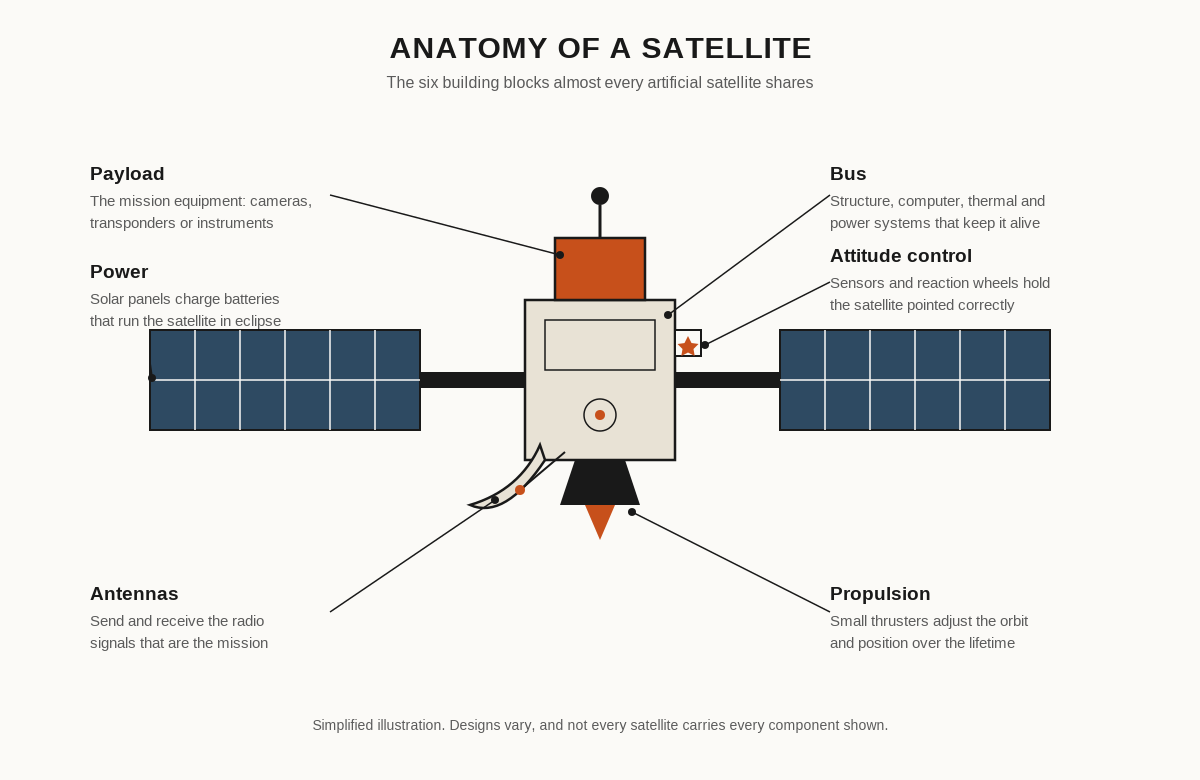
- Bus
- The supporting structure and shared systems that help the satellite operate.
- Payload
- The instruments or equipment that carry out the mission.
- Power
- Supplies energy, often using solar panels and batteries.
- Antennas
- Send and receive radio signals.
- Propulsion
- When fitted, thrusters can help adjust a satellite’s orbit or position.
- Attitude control
- Sensors and actuators help determine and adjust the satellite’s orientation.
Further reading: NASA: spacecraft systems.