
Types of satellites
THE GUIDE PURPOSES
Different missions, shared space
Satellites can be described by what they do. A single satellite may serve more than one purpose.
Communications
Relay signals for services such as television, phone calls and internet connections.
Navigation
Transmit signals that receivers can use to calculate position and time.
Earth observation
Collect images and measurements of land, oceans and the atmosphere to help us study our planet.
Weather
Observe clouds, storms and other atmospheric conditions to help forecasters.
Science
Carry instruments that help researchers study Earth, other celestial bodies and the universe.
Further reading: NASA: satellites NASA Earthdata: orbits
A CLOSER LOOK ANATOMY
Inside an artificial satellite
This is a simplified illustration. Designs vary, and not every satellite has every component shown.
Open the SVG to zoom in on its labels.
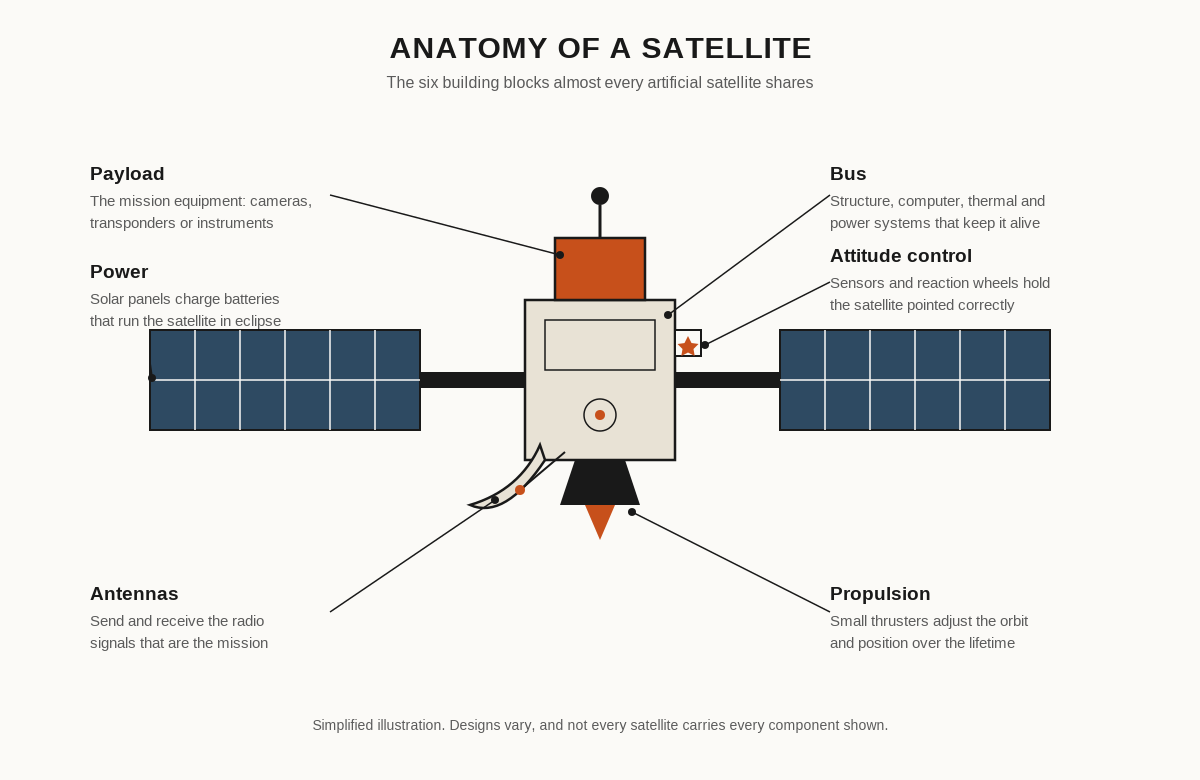
- Bus
- The supporting structure and shared systems that help the satellite operate.
- Payload
- The instruments or equipment that carry out the mission.
- Power
- Supplies energy, often using solar panels and batteries.
- Antennas
- Send and receive radio signals.
- Propulsion
- When fitted, thrusters can help adjust a satellite’s orbit or position.
- Attitude control
- Sensors and actuators help determine and adjust the satellite’s orientation.
Further reading: NASA: spacecraft systems.